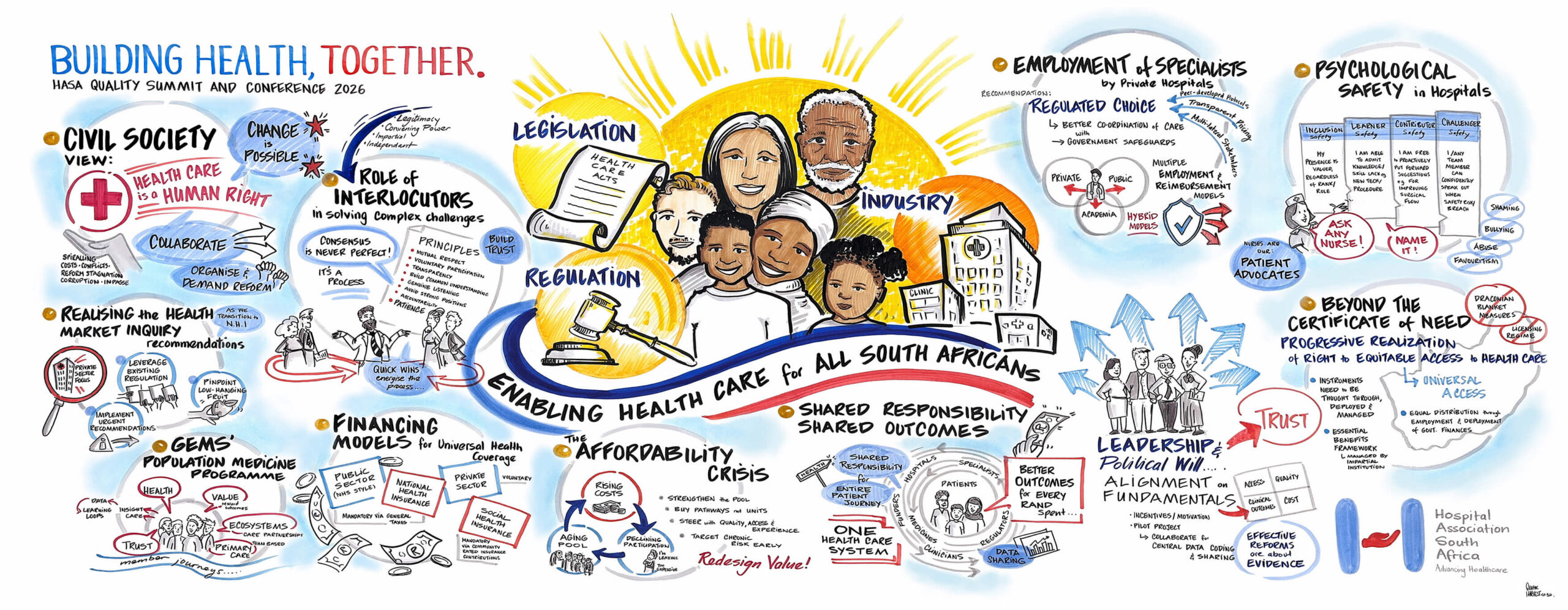
Ask 10 delegates what stayed with them from the HASA Quality Summit and Conference 2026, and you will get 10 different answers. Yet nearly all of them would end up in the same place: healthcare works only when its parts work together.
That was the theme – Building health, together – and across three days (30 September to 2 October 2026) it ran through session after session, from AI and end-of-life care to the cost of cover.
The graphic you see with this round-up was created live at the event by Graphic Harvest, a South African business that specialises in ‘graphic harvesting’: listening carefully to a discussion and synthesising it, in real time, into an easy-to-navigate hand-drawn visual.
For delegates, it turned three days of conversation into a picture that is far easier to follow and remember than pages of notes. For HASA, it leaves a lasting record of the conference that can be shared online and explored long after the event.
Here are some highlights from the floor:
Reform needs everyone in the room
The opening panels set the tone, and the civil society view was blunt: healthcare is a human right, and change is possible – if people collaborate, organise and demand reform. The session on the role of interlocutors offered the practical corollary. Consensus is never perfect, it is a process, and quick wins keep that process alive.
Mapato Ramokgopa of the Competition Commission took the same message forward. The inquiry reported in 2019, but implementation has been limited. Its recommendations were designed as a package, and the Commission’s call was for regulators to stop working in silos, use the powers they already have and go after the low-hanging fruit first.
The affordability squeeze
If one topic kept resurfacing, it was cost. Paresh Prema of Alexforbes Health described a cycle: contributions rising faster than inflation (6% to 8% this year, against CPI of 4.4%), younger and more price-sensitive members buying down or leaving, an ageing pool, and costs rising again.
With median household income at about R95,000 a year, he argued, even the cheapest option is out of reach for many South Africans.
The Council for Medical Schemes added the regulator’s numbers. Dr Musa Gumede reported that schemes covered about 9.17 million people at the end of 2024, yet membership grew by just 0.45% while benefits paid rose by 8.52%.
The ways out, as the graphic puts it, are to strengthen the pool, buy pathways rather than units, steer members towards quality and target chronic risk early. Or, in Prema’s words, the crisis “will not be solved by shifting costs, but by raising value”.
Technology, data and dignity
The conference was just as thoughtful about the human side of innovation. Professor Jennifer Chipps called AI “the new electricity”, and asked what clinicians should still be able to do without it.
Professor Keymanthri Moodley preferred “augmented intelligence” to the robot-doctor debate and noted that more than 90% of patients want to know when AI is used.
Design was also at the heart of the session on neurodivergence. Dr Marisa Roets argued that vulnerability can emerge “in the space between the person and the system”, and that small changes to light, sound, waiting and communication can transform a patient’s experience.
The final session of the first day took on the hardest conversation of all – how you decide that further treatment is futile. Dr Michelle Meiring’s line – “just because you can doesn’t mean you should” – was a reminder that the cost of doing everything is not only financial.
The missing piece
One recurring observation that came up over all three days, was that by and large, the patient’s voice was missing from conversations that fundamentally concern them. It’s something everyone in the sector should take to heart – that patients need information and agency as much as other stakeholders in the industry do.
As Andile Ncube from Tekano put it, in relation to marginalised patients, “Nothing for us without us.” But the principle holds for every patient: those who pay for healthcare, use it and live with its outcomes should help shape it.
Explore the full picture
The graphic holds more than any summary can: financing models for universal health coverage, GEMS’ population medicine programme, the debate beyond the certificate of need, and the leadership and political will that tie it all together.
At its centre sits the sentence the whole conference was working towards: enabling healthcare for all South Africans.